Stop using Webhooks: How FreeSWITCH SmartStream Brings AI Inside the Media Engine
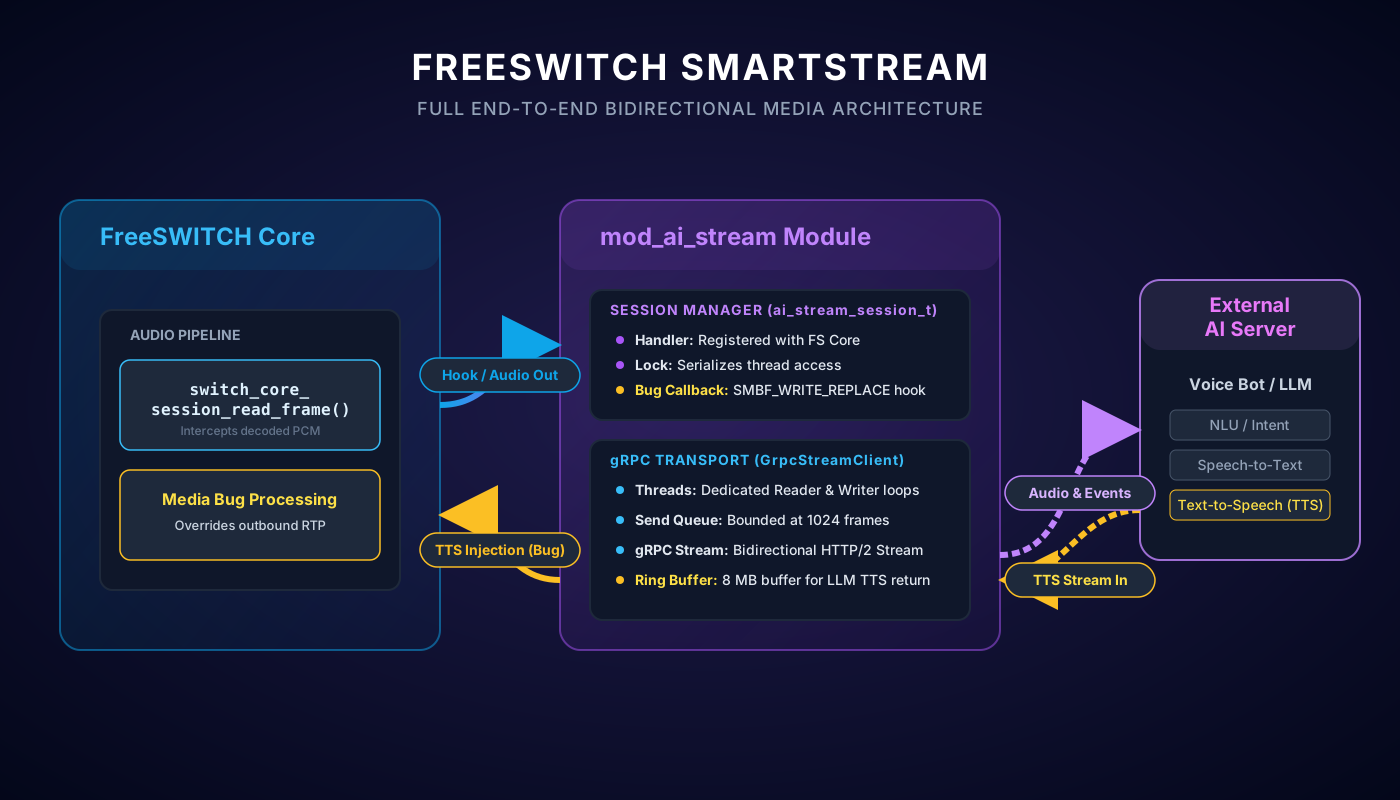
If you are building Voice AI infrastructure today—whether it's for low-latency voice bots, real-time sentiment analysis, or large-scale transcription—you are likely running into a critical bottleneck: the orchestration boundary.
Major CPaaS providers like Twilio, Telnyx, and others have standardized on a "bolt-on" architecture. They use WebSockets combined with JSON-encoded audio (or binary WebSocket frames wrapped in JSON metadata) to stream media out of the telecom stack and into an application-layer backend.
We call this approach "Prompt and Pray." When inference lives in the application layer, every decision round-trips through HTTP, and behavioral enforcement gets handed to a stateless text predictor over a fragile WebSocket connection. It's where most production voice AI burns its latency budget.
Today, we are thrilled to introduce FreeSWITCH SmartStream (mod_ai_stream), a revolutionary approach that eliminates the WebSocket bottleneck by running a high-performance gRPC transport directly inside the RTP media stack, while allowing your Voice AI pipeline to remain securely external.
The Problem with Bolt-On Architectures
Let's look at how the industry currently handles media streaming to AI, and why it fails at scale:
- The Media Bug Bottleneck: In traditional systems, to get audio out of a call, the engine attaches a "media bug" to the channel. This mechanism intercepts the audio frame by frame, copying buffers and adding significant CPU overhead.
- WebSocket & JSON Overhead: The audio is then base64 encoded and wrapped in a JSON payload, or sent as binary frames over a TCP WebSocket connection. JSON serialization and base64 encoding are incredibly CPU-intensive tasks when performed 50 times a second per channel.
- Application-Layer Orchestration: Waiting for audio to traverse the boundary from the C-based telecom stack up to an external HTTP webhook or WebSocket server introduces unpredictable latency spikes—a death knell for natural conversational AI bots.
Enter FreeSWITCH SmartStream: The Transport is Code, Not WebSockets
While your AI models and orchestration logic run externally where they belong, FreeSWITCH SmartStream ensures the transport mechanism is not a webhook. It is a highly optimized C module that sits directly inside the media processing pipeline.
Instead of tapping the channel with a heavy media bug, SmartStream utilizes a direct 7-line core hook that fires after decode and before media-bug processing. It has direct access to the audio stream.
- Native Protobuf Framing: Audio frames and control metadata are multiplexed over a single HTTP/2 gRPC stream using Protocol Buffers. Behavior gets enforced in code via strongly-typed schemas—not JSON parsing guesswork. This cuts serialization costs by 10x.
- Bypassing the WebSocket Boundary: By hooking directly into the core read path inside the RTP stack, we eliminate the buffer copying overhead of traditional taps and stream directly to your external AI server. The result? ~80% less per-frame CPU utilization.
- True Bidirectional Support: For Voice Bot use cases, SmartStream supports a highly optimized write-path. TTS playback is injected directly back to the caller via an
SMBF_WRITE_REPLACEring buffer, ensuring the lowest possible latency from the LLM back to the user's ear.
The Performance Difference
When you embed the transport and framing logic inside the RTP stack itself, the architectural advantages for your external AI pipeline are glaringly obvious:
| Feature | Twilio/Telnyx / Application Layer | FreeSWITCH SmartStream (Media Layer) |
|---|---|---|
| Transport Architecture | Bolt-on (Webhooks / WebSockets) | Embedded inside the media engine |
| Transport | WebSocket (TCP / HoL blocking) | gRPC (HTTP/2 Multiplexed) |
| Serialization | JSON / Base64 | Native Protobuf (Typed Schemas) |
| CPU Impact | High (Media Bug + Base64 + JSON) | ~80% Lower (Direct Hook + Protobuf) |
Getting Started
FreeSWITCH SmartStream provides a dead-simple API for your dialplan, handling the full lifecycle of the stream natively:
# Start streaming a call directly to your AI Server
uuid_ai_stream <uuid> start grpc.internal.net:50051

# Send custom control metadata using typed gRPC schemas
uuid_ai_stream <uuid> send_payload '{"intent": "billing"}'
Because it uses standard gRPC, you can write your AI orchestration in Python, Go, Rust, or Node.js with native, strongly-typed generated code, confident that the media transport is being handled safely in C.
Ready to Scale Your Voice AI?
Stop sacrificing your latency budget to WebSocket overhead and application-layer orchestration. FreeSWITCH SmartStream is built for carrier-grade Voice AI infrastructure.
Contact Sales to learn how you can deploy FreeSWITCH SmartStream in your infrastructure today.
Related Resources
Building & Installing FreeSWITCH 1.11.2 from Source on Debian 13 (Trixie)
A comprehensive guide to building FreeSWITCH 1.11.2 with SpanDSP, Sofia-SIP, LibKS, and SignalWire-C from source on Debian 13 Trixie.
Building & Installing FreeSWITCH v1.11.0 from Source on Debian 13 (Trixie)
A comprehensive guide to building FreeSWITCH v.1.11.0 with SpanDSP, Sofia-SIP, LibKS, and SignalWire-C from source. Learn the streamlined installation process on Debian systems without legacy dependencies.
How to Install & Compile FreeSWITCH v1.10.12 (Ultimate Guide)
Step-by-step tutorial to install and compile FreeSWITCH v1.10.12 from source on Debian/Ubuntu. Master dependencies, fix common errors, and deploy like a pro.
Discussion0
Join the conversation
Sign in with your preferred account to comment, reply, and keep the discussion useful for other engineers.
Takes a few seconds. No separate password required.